
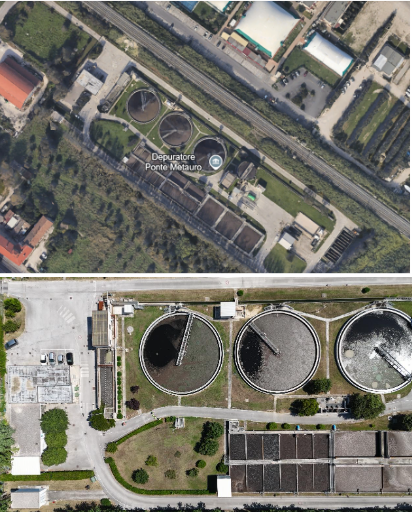
This project engages students in using drones and smart environmental sensors for advanced management and auditing of urban water infrastructure. Participants configure and deploy a drone equipped with a BME680 sensor and an MQ-7 sensor at the Aset S.p.A. Wastewater Treatment Plant in Fano, located in Fano and operated by Aset S.p.A., the local waste management organization.
Urban and industrial wastewater treatment focused solely on meeting chemical-physical parameters for the final water discharge. However, modern treatment plants must also manage localized atmospheric impacts, controlling diffuse odor emissions (sulfur compounds, ammonia, VOCs) and gases derived from biological stabilization processes. Inspecting vast areas occupied by open hydraulic tanks, flow channels, and sludge processing lines using traditional ground tools is a slow, partial, and logistically complex operation due to physical barriers and industrial walkways. Integrating a multi-sensor payload onto a drone allows students to map the aerial dispersion of volatile substances across different treatment sections in real time, comparing flight telemetry directly with routine analytical samples executed by plant technicians.
Measuring air quality and capturing CO levels above open tanks or near pre-treatment sections often requires the installation of scaffolding or exposes operators to concentrated fumes in confined spaces. An aerial robotic approach resolves these safety constraints. Students assemble the acquisition logger, integrate it onto the drone, plan an automated flight path based on spatial waypoints, and execute the mission while monitoring safety parameters. This process allows them to visually map the atmospheric footprint generated by different phases of the water purification cycle, evaluating the effectiveness of air extraction and abatement systems installed at the facility.
Urban wastewater treatment processes are uniformly regulated across the European Union by the Urban Wastewater Treatment Directive (Directive 91/271/EEC). Consequently, the functional layout (screening, oxidation, sedimentation, sludge line) present at the in Fano is aligned to that of any other wastewater treatment plant in Europe. Training centers can easily replicate this curriculum locally by collaborating with their regional water utility managers. Using simple environmental sensing hardware and commercial drones ensures project implementation within accessible budgets, qualifying specialized technicians to manage green transitions and monitor environmental parameters.