
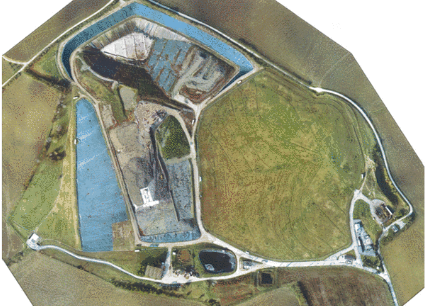
This project engages students in the use of drones and environmental sensors for the advanced management of urban infrastructure. Participants deploy a drone equipped with a BME680 sensor and a MQ7 Gas sensor at the Monteschiantello controlled landfill for urban waste in Fano, operated by Aset S.p.A., the local waste management organization.
Historically, open-air dumps posed severe risks to human health and ecosystems due to the unregulated release of greenhouse gases and toxic leachate. Modern controlled landfills solve this challenge by engineering closed containment systems that isolate waste from the surrounding environment. However, inspecting vast hillside terrains for fugitive micro-leaks using traditional ground tools is slow, and logistically complex. Integrating an air quality sensor onto a drone allows students to map the efficiency of topsoil capping and the integrity of energy extraction networks in real time, comparing flight telemetry directly with the facility's permanent ground monitoring grid.
Measuring air quality and capturing CO levels using ground sensors often requires many site visits and long periods of work in hazardous terrain (unstable industrial ground or steep landfill cells). These ground methods are slow and may only cover small areas. Students set up an air quality logger, attach it to the drone, plan a strategic flight path, and operate the aircraft. Safety considerations are frequently integrated into operations. This process allows students to visualize the hidden "environmental footprint" of a modern waste containment facility while evaluating engineering safeguards designed to protect the local community over a long-term horizon.
Because modern waste management infrastructure is strictly standardized by European Union environmental directives (such as the EU Landfill Directive), the operational zones, piping networks, and monitoring protocols found at the Monteschiantello facility exist in virtually every controlled landfill across Europe. VET providers can easily replicate this curriculum locally by requesting the standard "Environmental Monitoring Map" from their regional waste management authorities. Furthermore, by utilizing low-cost, open-source sensing hardware,