
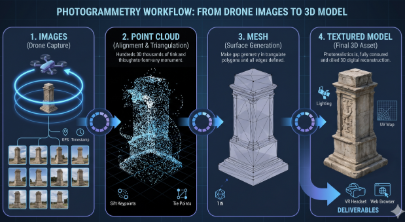
This project aims to create a high-quality 3D digital twin of historical monuments or archaeological artifacts using the DJI Mini 4 Pro drone and open-source photogrammetry software. The main objective is to digitally preserve cultural heritage elements by generating accurate and realistic 3D models through aerial image processing techniques.
In the project, the drone performs manual or autonomous circular flights around an outdoor historical structure such as a statue, monument, ruin, or archaeological remain. During the flight, high-resolution photographs are captured with approximately 70–80% overlap to ensure successful photogrammetric reconstruction. Different flight heights and camera angles are used to collect detailed visual data from all sides of the object.
After the image acquisition stage, the collected photographs are processed using open-source software such as Meshroom, OpenDroneMap, COLMAP, Blender, or CloudCompare. The software analyzes common points between images, calculates camera positions, and generates sparse and dense point clouds. These point clouds are then converted into textured 3D mesh models representing the exact geometry and surface details of the historical artifact.
The resulting digital twin can be used for cultural heritage preservation, archaeological analysis, restoration planning, virtual museums, tourism, and educational purposes. The generated 3D models also provide long-term digital archives against risks such as erosion, natural disasters, vandalism, and environmental degradation.
Compared to traditional laser scanning systems, drone-based photogrammetry offers a lower-cost, portable, and accessible solution while still achieving high levels of accuracy. The project additionally supports interdisciplinary learning by combining drone technology, computer vision, digital modeling, archaeology, and heritage conservation.
Ultimately, the project demonstrates how UAV technologies and open-source photogrammetry tools can contribute to the sustainable preservation and digital documentation of humanity’s historical and cultural heritage.